Steve McQueen ATLAS
De Pont Museum Tilburg
21 March - 30 August 202629-04-2026
The universe coming into being. On a grand scale, those concatenations of stars being born and particles flying and banging—we might be able to imagine such expansiveness, but we don’t know it, we haven’t seen it. Then there’s the mysteries of our own universe: our lives and how they began, the stuff of stories and lineage organized and bounded and also happenstance. The collision of these two scales of existence can seem bombastic and abstract. Containing this vastness or making sense of it without diluting its beauty and its terror is at the center of “ATLAS,” Steve McQueen’s new solo exhibition at De Pont in Tilburg. “ATLAS” consists of just four works, three recent and one new, across different mediums: sound, photography, immersive video and pixelated data.
McQueen is a powerful figure in both the art and film worlds, and his recent projects (such as his Grenfell memorial, shot from a helicopter as the apartment block still smoldered, or the transformation of Basel’s Schaulager into a gargantuan sound installation) can feel grandiose and distant. “ATLAS,” all caps, would seem to propose a great feat of art making—and who better to bear the weight of the heavens than McQueen, Oscar winner, knighted by the Queen, our own local (Amsterdam) celebrity? But even if his work is often large in scale and scope—reaching to the pit of the world’s deepest goldmine, or in the case of his newest work, across the Milky Way—there’s something intimate, even internal at play. Some have called this a “haptics” of McQueen’s images, which pulsate with sound or slide across the gallery floor to apprehend the viewer. “ATLAS” is interested in the cosmos, in what it might look like, feel like to bear its weight. But McQueen considers the weight of lineage, (personal) history, body and soul of equal importance. There’s also the weight of violence, a force that sits around and within the worlds McQueen maps. At De Pont, violence, whether the destruction wrought by colonization or the gaseous and ungraspable soup of outer space, is also, discomfitingly, a source of life.
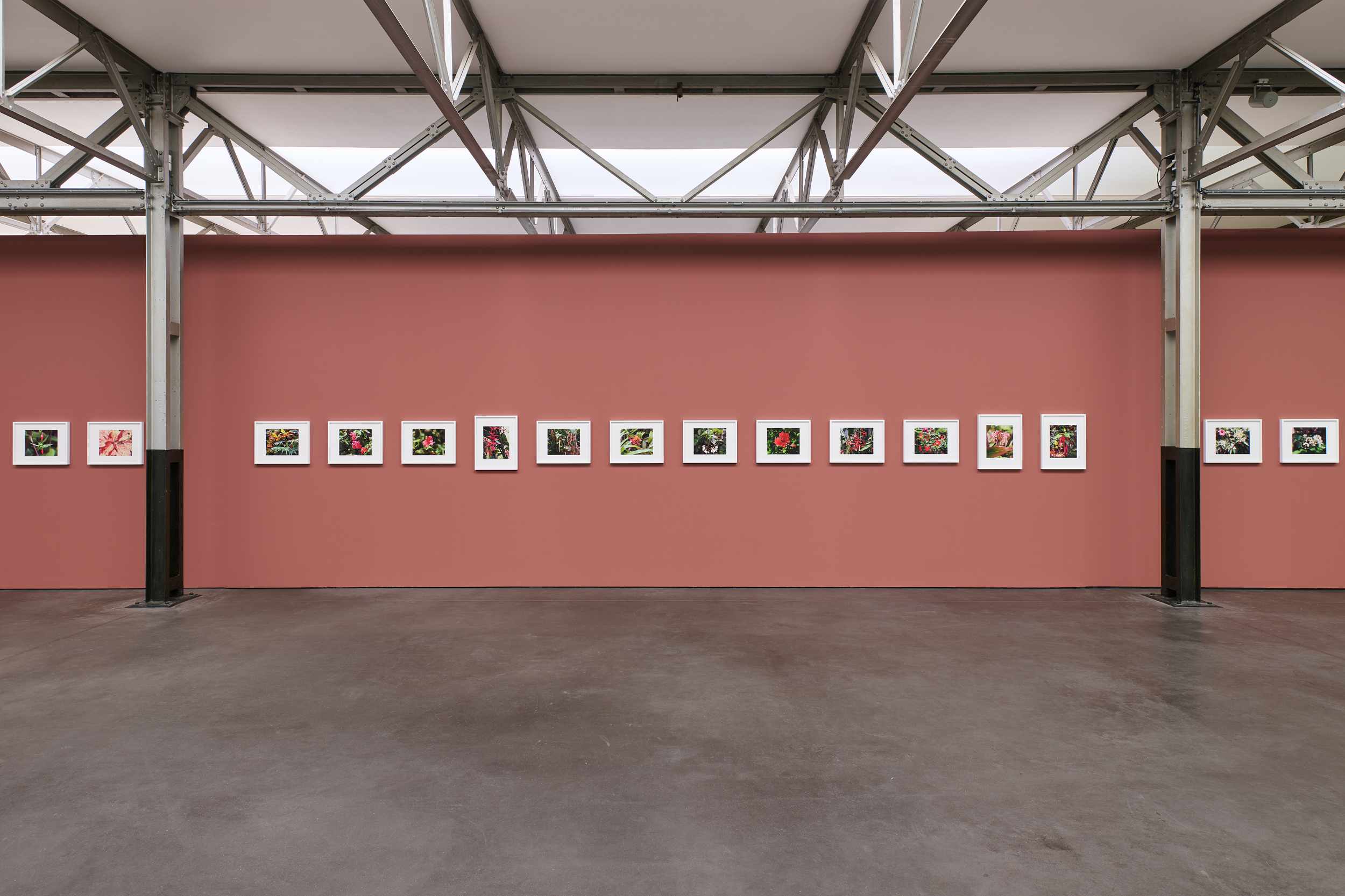
To reach the exhibition’s eponymous work, newly commissioned by De Pont, the visitor must proceed first through Bounty (2024), a series of 40 small, closely-cropped photographs of flowering plants in Grenada, the birthplace of McQueen’s father. Hung at shoulder height on a reddish-brown wall, the images are arrestingly frontal. Each flower arcs toward the viewer open and vulnerable, but also in a defensive posture like a cat unsheathing its claws. The tension between what has occurred outside this tight frame, the traumas visited on the land and on its inhabitants, has been the subject of much of McQueen’s work. But here, the tension between abundance and destruction is unnervingly straightforward. This clarity, the crystalline pinks and reds and yellows of Grenada’s horticulture, feels like a grounding experience ahead of the main event unfolding in the darkness of an adjacent gallery.
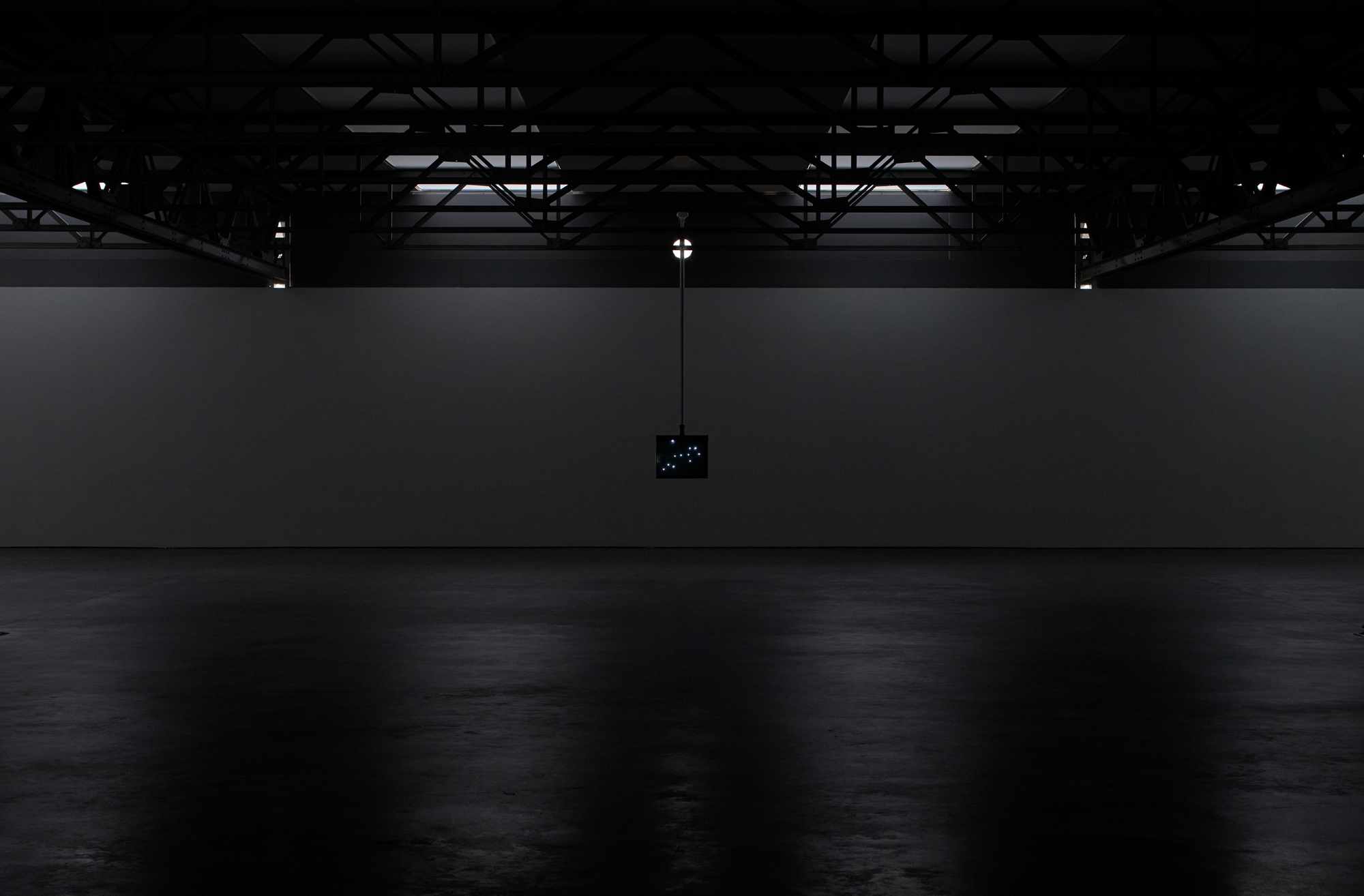
Atlas (2026) consists of four ancient monitors, each affixed to a pole that hangs low from the scaffolding and arranged along four sides of the museum’s immense central gallery. Each displays a spray of stars, a galaxy that appears to be moving in slow motion. To approach one monitor for closer inspection, however, is to abandon this mirage as stars reveal themselves to be white pixels that don’t float or stream so much as lurch across the screen. Up close, we see not the heavens but data. The monitors, dwarfed by the vastness of the room, appear like distinct yet unremarkable objects, especially up close. But as a quartet they create a circuit of movement that scrambles our vision and sense of orientation even as their organization in space evokes the compass rose. One doesn’t need to watch McQueen’s explanatory film on the other side of the museum to understand that what is actually being reproduced here is much bigger than what the simple graphics suggest. It’s more than a decade’s worth of astronomical measurements and observations captured by Gaia, a space telescope commissioned by the European Space Agency. The breadth of this information and the territory it maps is hard to fathom, and the work can seem ambiguous about whether to contain its possible limitlessness or to let it simply flow. I liked this ambiguity. After all, McQueen’s works have always grappled with the frame as a disciplinary device or a form of protection. In the center of the hall, surrounded by a galactic past and future, I found I had the capacity to assimilate what I saw without snuffing out its majesty. I thought of city lights, of the Joni Mitchell lyric, “city light time, must you get ready so slow,” of the phrase “blowing up your life,” of lights in the distance, lives lost and persevering, and then there were the lights on the screen, an incomprehensible atlas streaming and plodding and almost beautiful.
And then the frame begins to combust. In a small side room, tucked away at the front of the exhibition, Untitled (2025) reveals the source of an ambient thunder that hangs around Atlas and Bounty. Inside, we must quickly orient ourselves to pitch blackness. I bumped into a wall; I groped a curtain. And then came the sound. Pummeling. Assaultive. A fist striking a punching bag again and again, or a basketball slammed against the floor accompanied by the squeak of shoes, or something wholly different and much worse. Acclimation to this enclosed space seems only possible as the furious activity wanes and is replaced by labored breathing. A small light illuminates the outline of seven large speakers mounted to the walls. There’s an unremitting disorientation, a sense of being completely encapsulated by, inside of, the medium. Sound becomes space, it usurps the other registers of knowing and discerning we encounter in Atlas. This foreclosing of vision is given sensorial dimensions inside the dark chamber, where sound seems to transect us. Difficult to anticipate and impossible to escape without fleeing, this brute force cannot be differentiated from wall, floor, shadow, body. There’s violence here, yes, and there’s also intimacy. Their coexistence, co-constituency, seem both a fact of history and a fact of life for McQueen.
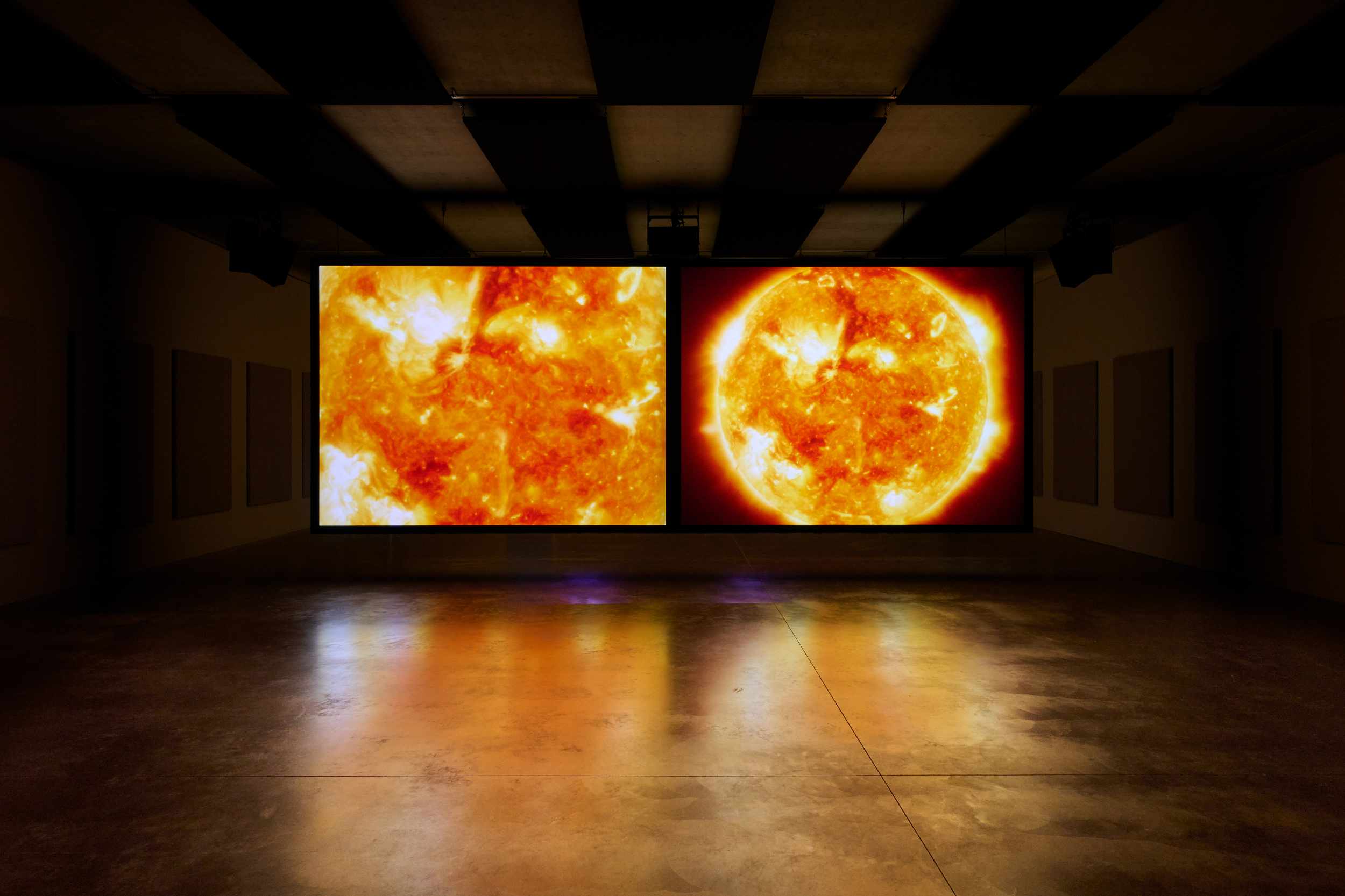
Across the museum, Sunshine State (2022), a two-channel projection beamed across a large screen entangles family, origin and their attendant traumas with the racist machinations of modern entertainment. Over scenes from Al Jolson’s 1927 film The Jazz Singer, McQueen tells a story relayed to him by his father Philbert shortly before he died: that as a migrant fruit picker in the 1950s, Philbert narrowly escaped death at the hands of a white mob. As McQueen narrates the story, a pivotal moment from The Jazz Singer in which Jolson’s character Jack—an entertainer who has fled his Orthodox Jewish family for a life in showbiz—applies the blackface of his minstrel act. Much has already been written about this work: its subversion of narrative through the breaks and ruptures that appear as McQueen repeats his father’s story; the inverted black and white image of Jolson putting on blackface, so that instead of transforming into a racist caricature—a founding image of the soon-to-be American media empire—he disappears before our eyes. What stands out in the context of “ATLAS” is the way the narrative format becomes recursive and a mirror: of Jolson’s own biography reproduced onscreen, of his visage and its erasure by McQueen, of a fractured father and son story, of atonement and assimilation.
The Sunshine State of the title is Florida, where Philbert’s story took place. It also describes the sun itself, which appears as a frothing ball of fire that cuts in on Jolson as he applies, reapplies and removes his racist mask. The sun is at the center of one screen; it careens across the other becoming an abstract topography of orange and white. The silence that permeates Jolson’s frenzied movements is replaced by a rumble and then by McQueen’s chanting “shine on me sunshine state/shine on me, shine on me.” The phrase transforms from a tongue twister to inveiglement to incantation as McQueen repeats words, rearranges syntax. A divination for that most elemental of frames, the sun, that casts shadow and creates life and makes it wither.