Geo Wyex
at ROZENSTRAAT – a rose is a rose is a rose & Playbill
6 September & 26 September 202620-10-2026
“I had a feeling I could be someone.” – Tracey Chapman
“I had a feeling I could be someone.” – Luke Combs
Cover story, cover girl. Cover identity; hardcover, softcover. Geo Wyex graced Amsterdam with two performances this past September, one in the Sarphatipark, and the other a performance for Playbill. Consider these two performances the front and back “covers” of this text. What they have in common is something about debt and escape; something about seeing yourself in a sad 2000s white woman seeing herself as a very sad Kurt Cobain; something to do with value, or (paraphrasing Derrida) the remedy that makes you sicker: but also something to do with paraphrasing itself, as a debtor’s practice. But I’m not sure I’m able to unpack all that just yet. No, as the writer, it is merely my job to light the path between the front cover and the back.
The first performance by Wyex was entitled Nobody Wade Never Too Much (2024-26), part of an ongoing body of work under the moniker Muck Studies Dept. The muck in question can be a kind of historical residue, but also something material, a clog in the cultural pipes. In one of its earliest iterations, Muck Signal from Muck Studies Dept. (2018), Wyex went deep with a rake into an algae-covered canal, like a municipal sanitation worker looking for a particularly stubborn blockage. This most recent performance in Sarphatipark was part of “Enter/Public/Stage,” hosted by ROZENSTRAAT and curated by Sanneke Huisman and belit sağ. Wyex, dressed in a wrinkled suit, his face covered in powder-white foundation, approached the Sarphati Monument, a grand 19th century structure with no shortage of fountains or columns, looking slightly preoccupied, like an absent-minded professor. He reminded me of a math teacher I once had, whose suits were similarly unkempt, as if he had just gotten up from a nap on a couch in the teacher’s lounge.
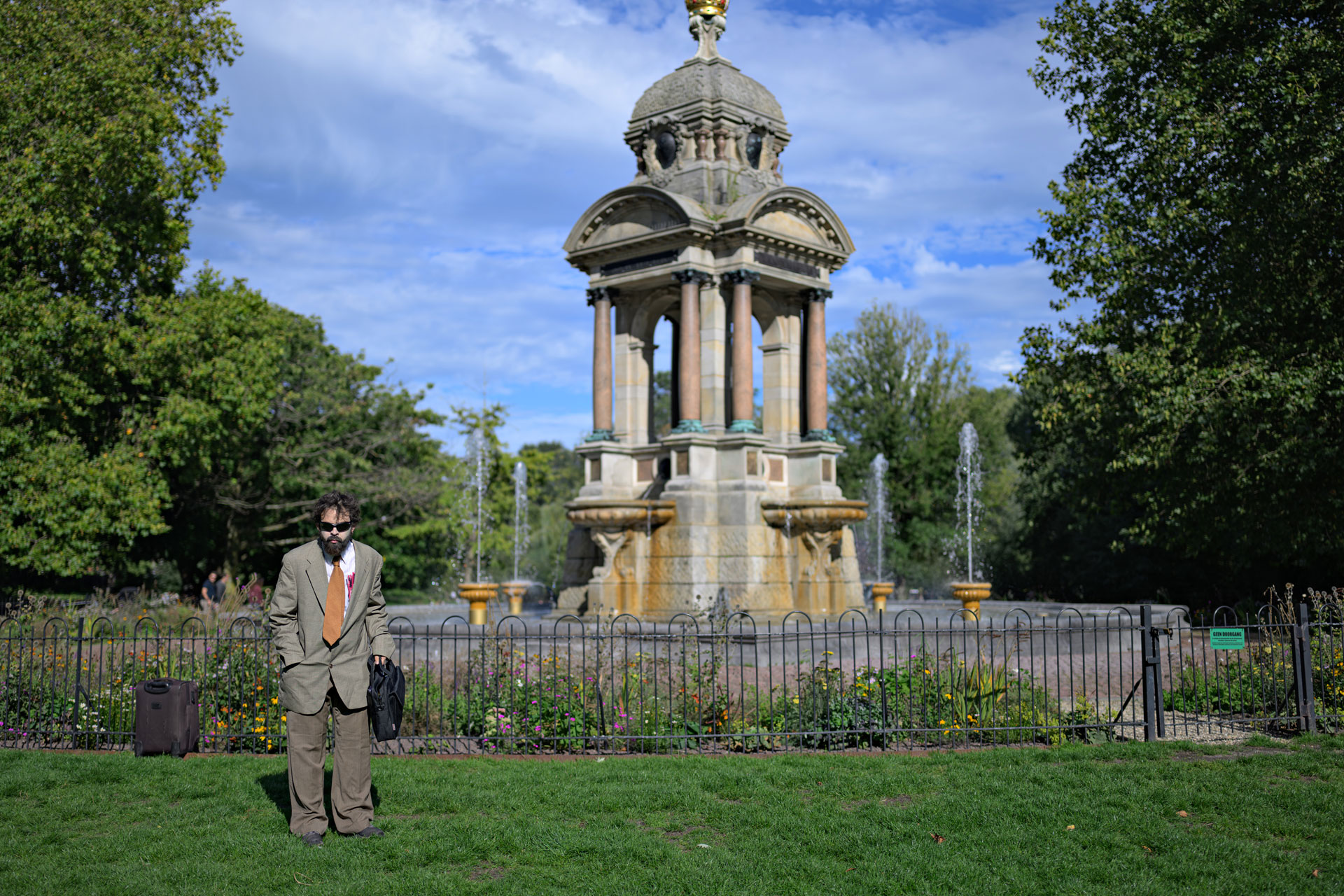
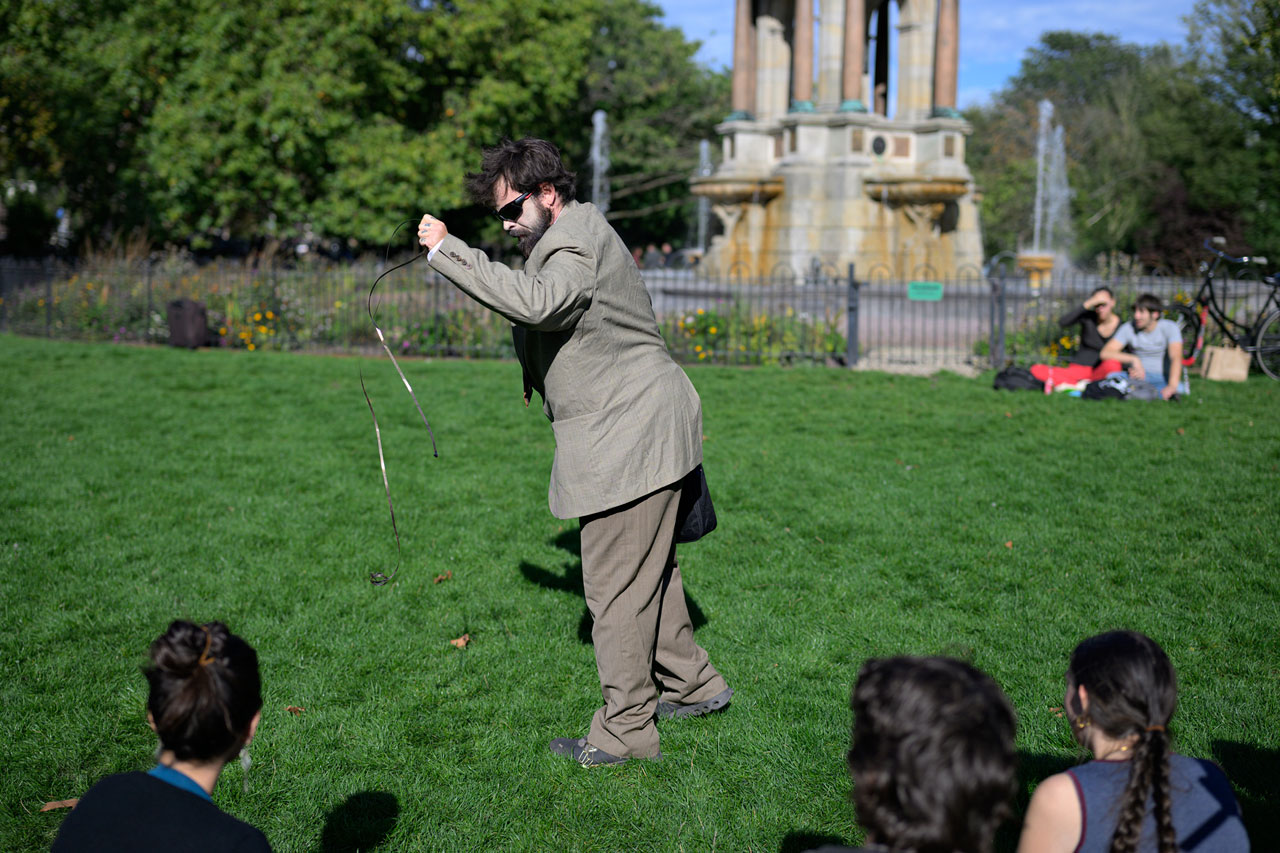
Wyex sometimes channels a pedagog when he elicits audience participation. “Does anyone know this song?” he asked as he fiddled with a portable radio (it turned out to be “Never Too Much,” by Luther Vandross). “We can’t hear it!” someone shouted. But Wyex’s disheveled academic, it turns out, is in a meeting, and is in a very bad mood—a feeling like a “box of donuts left out in the rain”. Wyex moved as he monologued, making his way across the park by laying spent fireworks on the grass, picking them up again, and repeating the gesture a few meters further on. This intertextual play of references, monolog, and call and response was punctuated by moments of near abstraction, such as when Wyex stiffly shuffled across a gravel pathway, perhaps our dyspeptic professor attempting to dance.
Wyex performed again at the end of September, this time for Playbill, a platform for text-based performance that hosts events at the miniscule Torpedo Theater in De Wallen, curated by Martha Jager and Isabelle Sully. When I entered the theater, Wyex was already playing at the piano, idly chatting with a puppet named Woosh, voiced by artist Lili Huston-Herterich. Wyex, in a wide, red tie and white collared shirt, described his outfit as “dressing like a man who dresses up as a man.” With Woosh, a shaggy brown dog perched atop his piano, the pair appeared something like Billy Joel on the Muppets, or an act from the Ed Sullivan Show. They had an easy rapport that felt either completely spontaneous or very well rehearsed as ad lib comments led smoothly towards moments of high theoretical discourse. While Wyex riffed on the phrase “Value is seen to escape” from Gayatri Spivak, Huston-Herterich’s Woosh plaid the naïf (“I myself was born yesterday, as you can see”), asking “Who’s that? A comedian?”
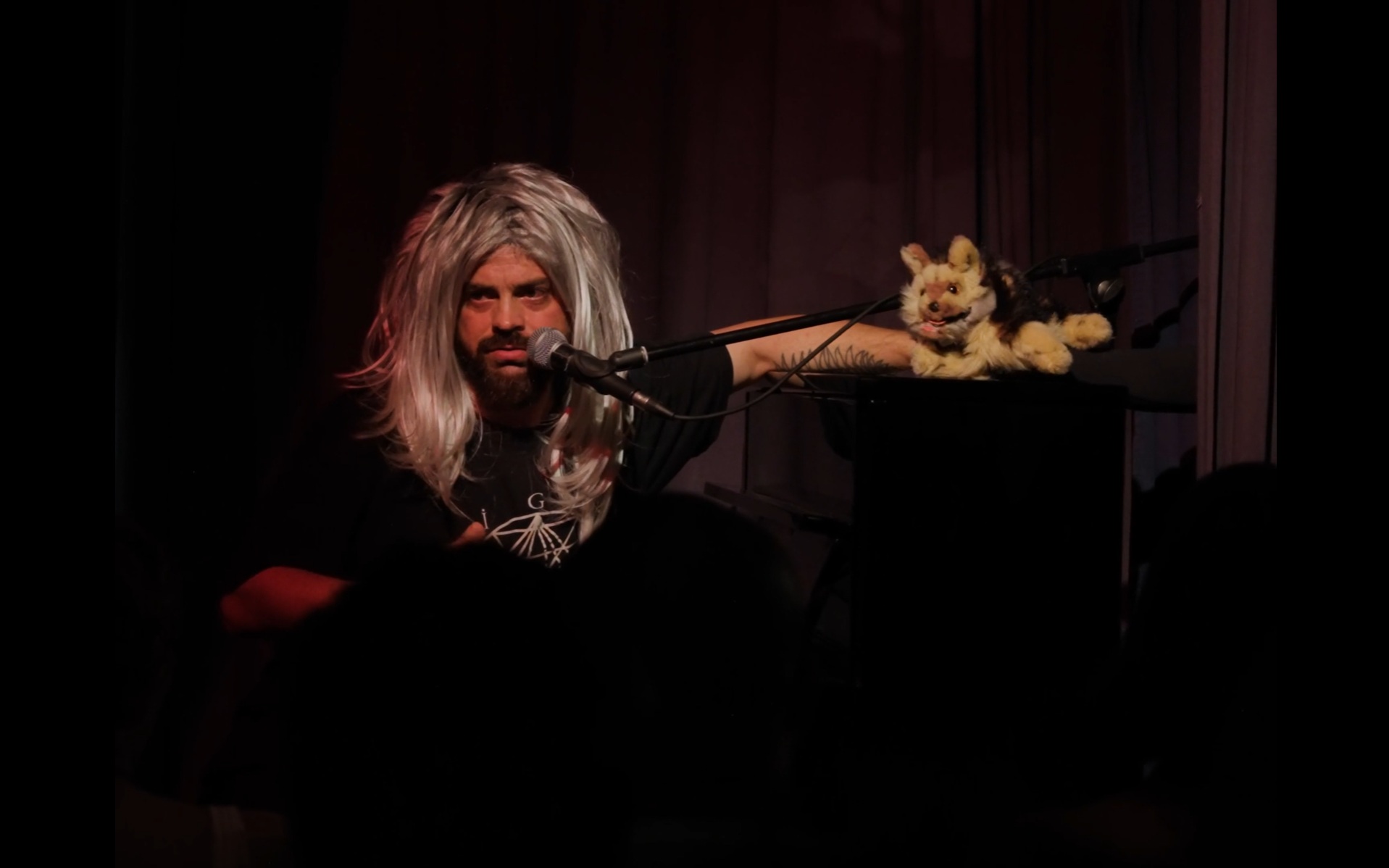
The performance, called Cover, was composed of a series of songs covered by Wyex and Huston-Herterich, interspersed (and often interrupted) by the two discussing, interpreting and speculating about the lyrics or original performers. While Wyex perhaps never got through more than a single verse without stopping, it is impossible to convey what made Cover work so well without describing his incredible talent as a musician. Somehow Wyex’s phrasing and musical interpretation did complete justice to his material, while also thoroughly manhandling it, for example in the cover of Gillian Welch’s melancholic “Everything is Free,” which midway turned into a polka sung by (what I can only describe as) a manic horny gerbil. Other covers, such as Cat Power’s “I Don’t Blame You” and “I am Changing” from the musical Dream Girls, remained more faithful to their heartfelt originals. Nonetheless, Huston-Herterich’s frequent interjections as Woosh did not let the audience linger in Wyex’s performance, however captivating. Wyex and Huston-Heterich moved through each cover in a constant process of musical interpretation, rehearsal and lyrical re-interpretation. Songs did not so much begin and end as fitfully mutate.
Wyex and Woosh had a tendency to spin out double meanings, misunder-standings, and shifts in point of view that turned each song into a kind of prism, in which the authorial original is replaced by a host of possible songs. In “Everything is Free,” for example, the word “free” was taken both as holding no (financial) value, but also a kind of freedom from any system of value, tapping into a latent utopianism. Later on in the same song, Wyex put particular emphasis on the lyric “If there's something that you wanna hear/you can sing it yourself,” reinterpreting the line from a professional artist’s umbrage at being asked to do requests, towards an open invitation, the very spirit of the cover song. You would be right if you sensed a whiff of the Barthesian “Birth of the Reader;” but that might also be the scent of last night’s drinks on the karaoke bar floor. Perhaps the most vertiginous moment of Cover was during the performance of “I Don’t Blame You.” Wyex explained that many fans believed that Cat Power had written the song about an on-stage meltdown by Kurt Cobain. Of course, Power was herself known for such difficult performances, often struggling through songs, stopping half-way through, muttering “I’m sorry” to her fans as she left the stage. At this point, Wyex had changed into a shaggy platinum blond wig and T-shirt, which, to my eyes, resembled Cobain, but Huston-Herterich’s Woosh interpreted him as the “sad 2000’s white girl” that formed a significant chunk of the setlist. Of course, we are both right, if Cobain was a kind of stand-in for Power (the sad white girl par excellence): the song’s subject and object simultaneously embodied. In such moments, it is hard to distinguish the prism of interpretations of each song in Cover from the prism of identities performing said songs; indeed, it feels like the indistinction is the point.
While discoursing on the song “I am Changing,” Wyex observed that change is not always intentional. Change, including (but not limited to) gender transition, Wyex suggested, could be something more unyielding, or already underway. I would add, at least as pertains to the cover song, that these points, self and non-self, artist and fan, or cover artist and recording artist, look longingly through each other in a mirror. I do not mean that they long for each other, but that they long past this other image, towards a feeling they could be someone.
***
The last cover of Cover was “Scum of the Earth,” a song Wyex released in 2012 on his album Alien Tapes. By “covering” his own material, Wyex posed his own repertoire as belonging, perhaps, to someone not quite himself. The song’s opening lyrics introduce us to a familiar showbiz inequity: “all the men get famous/and all the women get played.” What follows in the third line, however, suggests a third option, a kind of holding cell for those implicitly in neither gendered category: “There ain't nothing but the dungeon for the likes of me and you honey”. Ultimately these three positions (famous, played, dungeon) became the substance of the final act of Cover, as Huston-Herterich and Woosh went into the audience, asking which they would choose. Woosh played gently with each person’s reply, acting flirtatiously as someone answers “sex dungeon,” and braggadociously when another assertively says “famous.” But in the end, Woosh chose to get played.
While no one wants to get financially or professionally punked, that was not really the question. This “choice,” like the aforementioned “changing,” is not really a choice. The ones who get played seem to be the ones who make art because they simply can’t refuse. Or as Wyex as Gillian Welch sang:
Someone hit the big score
They figured it out
That we're gonna do it anyway
Even if it doesn't pay
But of course, “getting played” is also literally what is happening: Wyex and Huston-Herterich are playing the songs of Power, Holliday, Welch and Wyex. The cover is itself a kind of debt, not financial but creative, to other artists and their work.
I can’t help but think of the doddering professor of Wyex’s performance in Sarphatipark, bringing his bad mood to the faculty meeting. There are the famous and the played in academia for sure, where love (for teaching, for thinking, or for writing) can be a fatal weakness in contract negotiations. The professor is unproductive; his radio is not loud enough; he gives his class (the audience) assignments they cannot complete, readings they haven’t prepared; and of course he’s uncollegial. Wyex repeatedly asked, “why share such a feeling at the meeting?” as if he himself can’t explain it. But the question is rhetorical: no good can come of such displays, if by good we mean something with value, as in goods and services.
In fact, everything that tumbled out of Wyex felt like a parody of money and its symbolic objects. A gold chain inside his suit jacket turned out to be connected to two plastic cups, like the kind used to play “telephone;” from his briefcase he pulled out seashells. And then we have the song by Luther Vandross, whose relation to the performance I admit was not immediately apparent to me. In retrospect, the title “Never Too Much” and the song’s lyrics of love’s incalculable surplus, its unimaginable quantities (“A thousand kisses from you is never too much/I just don't wanna stop/Oh, my love/A million days in your arms is never too much”) are in stark contrast to the meager austerity of the budget, the figure that looms totemically over every department meeting. Vandross was himself well known for his cover songs. One of his most famous covers was of “A House Is Not a Home,” originally written by Burt Bacharach, but made famous by Dionne Warwick. Vandross’ version dramatically extends Warwick’s version, running seven minutes on his album, but often ten or more in live performance. Vandross found slow intensities that could somehow recover the seconds as they fell along the path of time: les temps retrouvé.
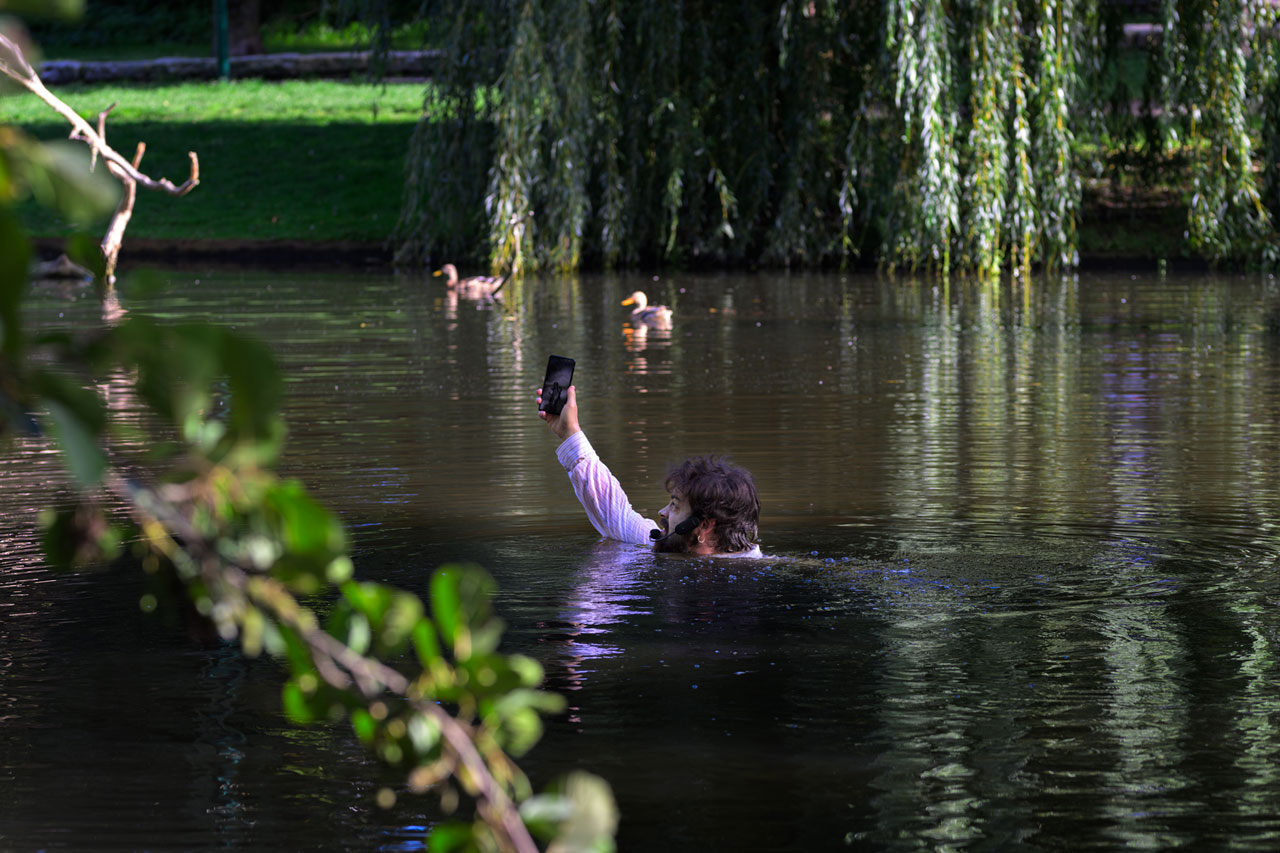
Taken together, Cover and Nobody Wade Never Too Much form a kind of methodology of debt. I don’t only mean debt as a lack of value, although that is of course always there. It’s there in the lack of value ascribed to Effie White, the character who sings “I am Changing” in the Dream Girls musical. White was created as a stand-in for Florence Ballard, a founding member of The Supremes who was removed from the group, as Diana Ross was elevated to frontwoman. While Ballard’s story ends tragically with a fatal heart attack at the age of 32, the character who sings “I am Changing” has a slightly more hopeful narrative. For our professor in the park, at least, this lack of value was a scene of escape (to twist the Spivak quote a little further), when Wyex swam across the Sarphati pond, emerging on the opposite shore, before running off into the park’s foliage. Dependence, or what we owe, is human; its violence, on the other hand, derives from the systems that govern it. Debt is not only exchange value, but a relation between artists, teachers and students, puppets and piano men. Maybe this is the “it” with which Cat Power absolves Kurt Cobain: “They never owned it / And you never owed it to them anyway / I don't blame you.” What can’t be owed or owned, a debt that is inversely a kind of collective wealth, like the surfeit of time Vandross gleaned from the metronome. Ideally, this type of debt is never paid off; hopefully, it spirals wildly, dizzyingly out of control.