Jesse Darling Godsworth
Oude Kerk
24 April - 27 September 202625-09-2026
It’s August 2026. Bubbly markets climb on the promises of artificial intelligence. The rich get richer; the poor poorer. Social media burns into our minds images of ongoing genocide, war, militarized borders, protein-obsessed wellness trends, self-administered ADHD tests. Some call it neo- or techno- feudalism. Did we forget we lived through a pandemic? Waves of populism rise. Heat domes engulf Europe and the Americas. Fires rage; ash rains. In January 1970, Stewart Brand, in the Whole Earth Catalog, noted the cultural flight from the powers of government, big business and church, quipping: “As if the spirits of our ancestors weren’t trouble enough, now we’re haunted by the ghosts of our descendants.”¹ 40 years later anthropologist Michael Taussig wrote that “climate gone terrorist” produces “preemptively apocalyptic knowledge,” an indefinite horizon of crisis.² Maybe this future looks better, optimized even, for those who believe they can plan their escape—their ascension—from this world, but what remains for the rest of us? In their final book, Lauren Berlant took as their subject the inconvenience of living with other people: a core condition of enduring sociality, and a call to continue showing up to participate in our “awkward and violent ordinary.”³ Whether a coping mechanism or part of a trend (or both), I find myself frequenting art exhibitions and performances, across Europe, this summer that step onto the club dance floor or into the cathedral nave—spaces historically better attuned to popularly soothing collective pain or pleasure than the museum or the white cube gallery.
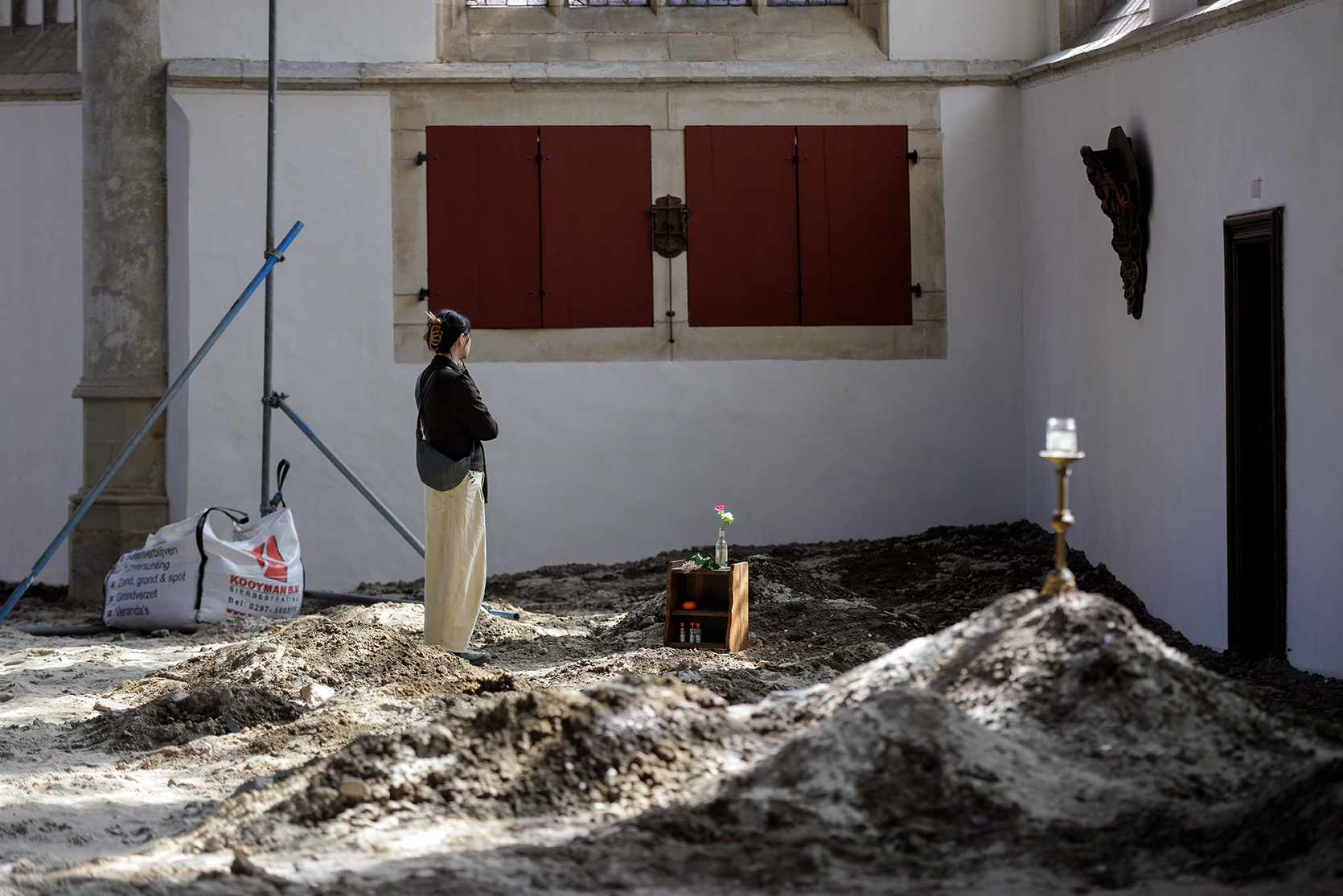
For centuries, Amsterdam’s Oude Kerk has served as a house of worship, a public market, a stock exchange, a communal grave site, an archive, a concert hall, and now a contemporary art museum. Its architecture bears the physical traces—the scars and repairs—of practical use and architectural additions, ideological reform, violent invasion, historic conservation. Former director of the Oude Kerk Foundation, Herbert van Hasselt, described the building itself as a “Living Museum,” most inspiring when left empty. Since moving to Amsterdam, I have attended concerts in the church at dawn, chilled by the dampness of the building’s stone. I have come to evening talks to listen and stare up at the fleeting light as it passes along the church’s heavy wooden ships beams now transformed into voluminous rafters. On my first visit, years ago, I instinctively knelt down to touch the worn gravestones underfoot. I learned later that over the centuries, with numerous floodings and excavations, the human bones beneath the floor washed here and there into a communal, material mass. Through word of mouth, I have gleaned sideways pictures of the complications of the church’s internal dynamics and its divergent public communities, which require conjoining conservative and progressive factions at odds over what stewardship of the institution’s history might entail. And I have visited art exhibitions. Some have treated the space like an uncomfortable white cube, avoiding or ignoring its complex contexts, while others have attempted to equally match its weighty presence.
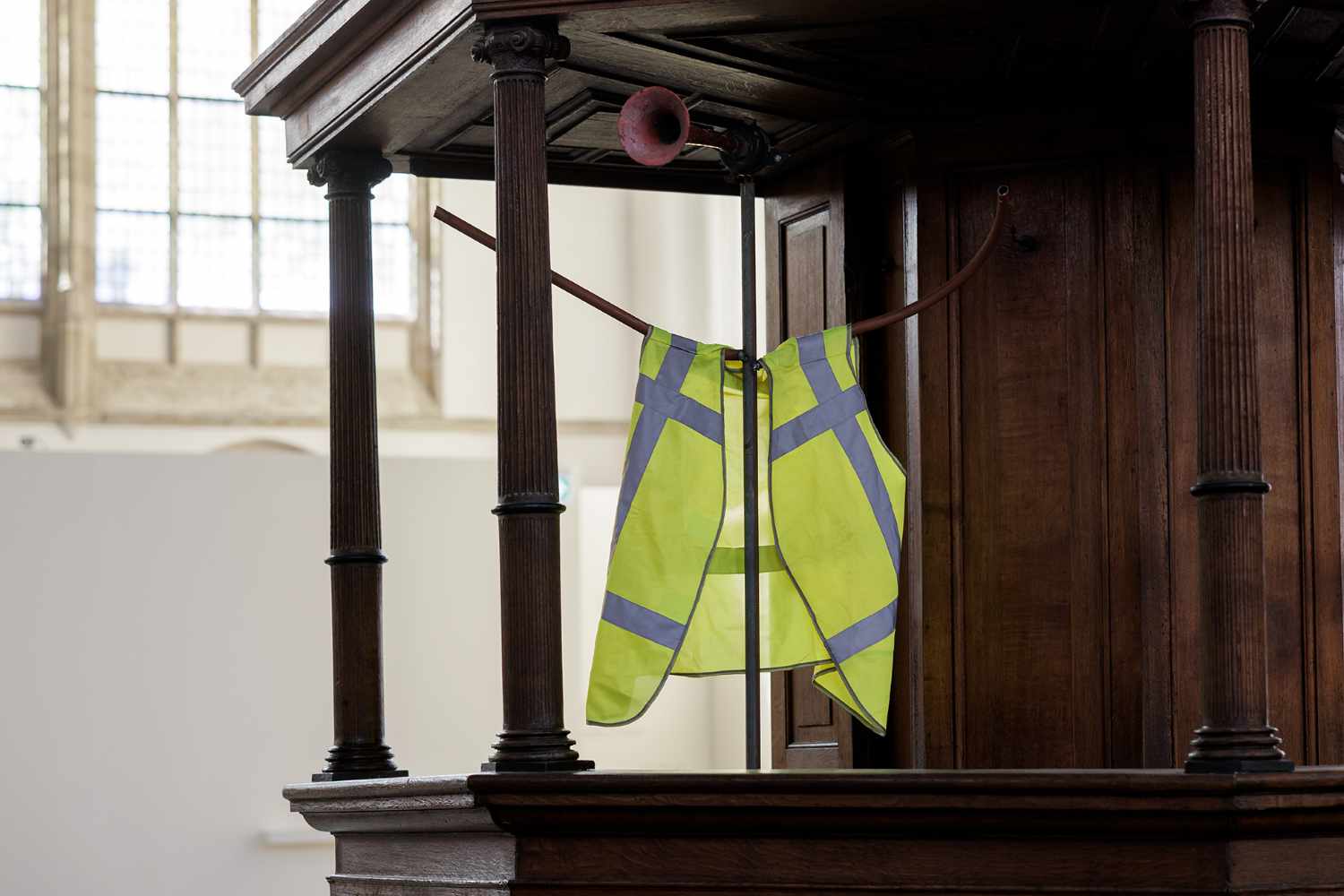
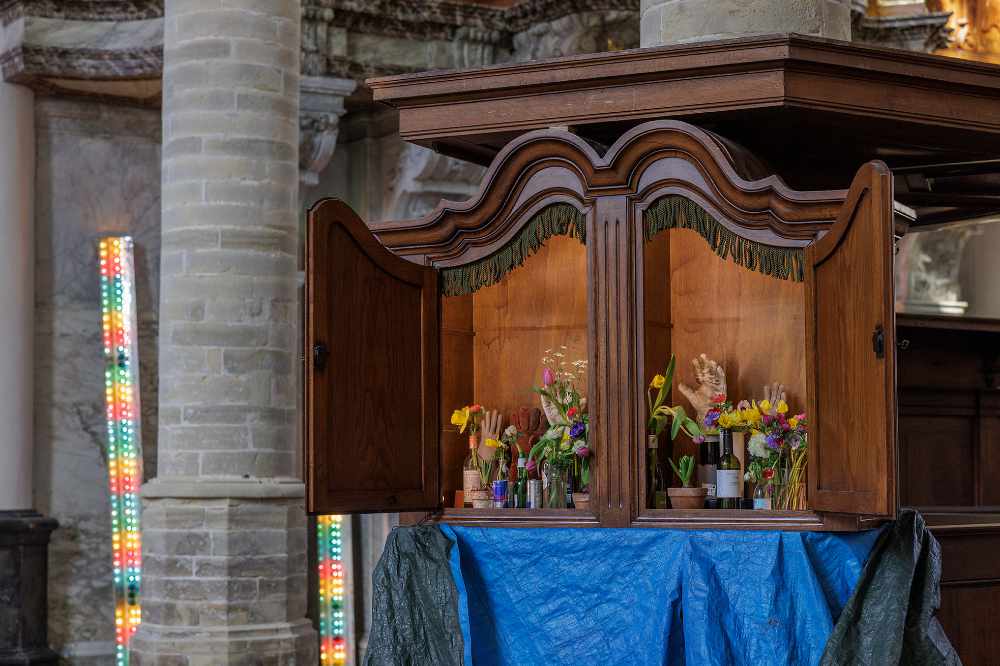
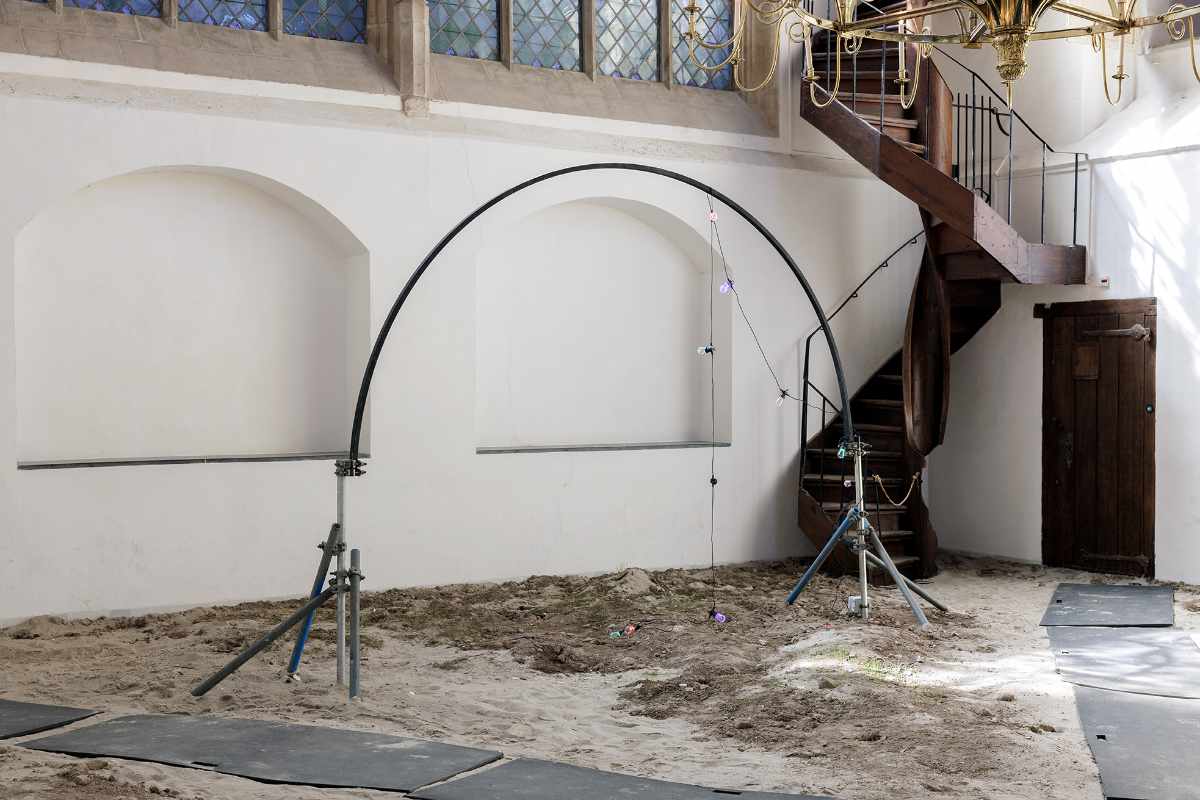
Entering the church, on this occasion to visit Jesse Darling's commissioned exhibition “Godsworth,” I drift among piles of sand, banks of overturned carnival lights and curated construction debris moved by the artist—directing a team of hired and volunteer assistants—into this house of God. These spreading dunes obscure many of the graves underfoot, yet also seep into their cracks and crevices, tracing and throwing into relief the stone inscriptions. Improvisational altars are strewn with flowers, staging spontaneous vignettes that suggest continuous institutional attendance. Thin steel archways and rings mirror those of the church’s barreled vaults and carved circular family crests, delineating outlines through which the ineffable might leak. Aged blue tarps drape and hang like altar cloth, contrasting sharply with the church’s ornate wooden interior. A towering mantle of the same weather-tattered ultramarine plastic hangs high in the church’s transept, hovering over the visitor like a wraith or an overly illustrative manifestation of the Holy Ghost. Scarecrow steel angels, outfitted with trumpets and neon construction vests, sit in the blocked off pews like forgotten props. Leggy saplings, bound to scaffolding pipes, arch towards the Dutch light: a painted picture of growth frozen just as it began. Elongated “stoles” made of baby blue paper towel rolls with stapled-on fringe dramatically drape from the overhead beams like flimsy priestly trappings for the building itself. Woven plastic construction sacks sag with sand and sprout or rip open to become veils for historic paintings of colonial vessels hung on the church’s columns. Arrays of colored light bulbs punctuate, encircle and frame the space in rings, wreaths and strands. This is a silently shifting theater set of salvaged material, in the round, and we, the visitors, become cast as its ghostly actors.
Moving within Darling's staged ruins in reverse, his projected imaginary of a world dug up and run aground, I feel a persistent request to attune to the nuances of someone else’s observations. I find that to access the spiritual and critical registers “Godsworth” proposes I, the viewer, must look at this assemblage and through it, to feel blindly for the institutional dynamics of the Oude Kerk, and for the crumbling social bonds, demolished buildings and living and dying dramas beyond these quiet walls. In this space, I feel at once shepherded toward other visitors and distanced from them, contained as we are within Darling’s constructed relationality. My ties to others, to the outside world here become dependent on a communion with the installation—with the institution—itself. “‘No ideas but in things,’ Warhol implied. ‘No ideas but in flesh,’ Thek countered.”⁴ No ideas but in this, I imagine Darling annotating. Here and across much of Darling's recent work, his sculptural constructions hang, slump, lean, branch and generally depend, in the most physical ways, on the institution’s architectures, to find shape—even as they suggest a desire to redirect, to depose, these very same structures at every turn. While I read in this space, and in other of Darling’s works, a crip politics—of bodily dependencies as radical forms of being in relation, chosen or not—I find myself wondering about the subtle tensions between the words “hermetic” (cryptic, exclusive, sealed, from herma, a stone pillar or heap) and “environment” (the relational, the surround, etymologically meaning to “turn in a circuit, a circle”), and where I am left in this drifting world of “Godsworth.”
After my first visit to the exhibition, I was left with an incompleteness: a chewing feeling that this plaatsgebonden (place-bonded) installation might only reveal itself through a prolonged series of encounters. I returned to “Godsworth” multiple times over the weeks. I watched a contemporary art crowd, excitedly whispering to each other, pausing in front of Darling’s impromptu altars and arches to capture streams of images on their phones. I noticed a pair of tourists studiously crop out Darling’s sculptural interventions from the frame of their digital cameras, as they searched for the cultural heritage they made this pilgrimage for. I visited on weekdays and a Sunday afternoon before vespers. One August evening the pastor opened the call and response … Heer, open mijn lippen. [Lord, open my lips]…God, kom mij te hulp. [God, come to my aid.] What is God’s worth if not his word? The sand surrounds, the atmosphere shifts. The carnival lights adorn the altars, the scarecrow “angel” construction workers sit in the pews alongside the congregation, the mushrooms and the sprouts and the dead below are oblivious to time, and I wonder what they find, here, in each other. I listened, waiting in line at the entryway, as Oude Kerk employees instructed visitors to please refrain from stepping on the sand—it’s alive, it’s growing, it’s an artwork.
Darling’s interventions feel oddly comfortable, inhabiting the space, even as I begin to envision how each grain of sand scattered across the graveyard floor threatens, with every visitor’s footstep, to scratch millions of minute marks into the church’s historically preserved stones. “Godsworth” subtly and overtly takes over the building’s pulpits and pews, stepping in, as a roving preacher might, to direct and redirect its congregation’s wandering eyes, wherever they might turn. The persona of the preacher I find suits the art world persona Darling has cultivated, as he publicly performs acts of searching: for how to live a life shaped because of (in spite of) the “successful” artist career he pursues. I find Darling’s self-aware deftness can sometimes all too easily dovetail with institutionalized performances of criticality and care, as he preaches a politics of resistance and kinship—allegiances with squatters, left wing activists, sex workers and the working class, here in a city Darling calls his second home. Elsewhere, his sculptures climb into the desirous beds of art fair booths and kunsthalles, amassing undisclosed amounts of capital. The church has always brought together a particular marriage of contradictions, of political theater and spiritual transcendence, that Darling’s work, and persona, too appear to regularly incite.
The longer I stay with “Godsworth,” the more I am visited by the echoes of iconic, male, gay artists of the 1980s and 90s—Derek Jarman, Paul Thek, Felix Gonzalez-Torres. Artists who strove for immanent forms of critique, and channeled a spiritual beyond, from within and without the grinding commodification of art world circuits. Paul Thek and The Artist's Co-op “processions” and environmental installations amass here, unseen in the shadows, in their messy authorial collectivities, carrying their baggage and construction debris, their broken and unruly contradictions of body and spirit, kitsch and class and the flamboyant perversities of life and death—played out on the cordoned off stages offered by European art world institutions. And, of course, the banks and rings of bulb lights chosen by Darling are quintessentially Felix Gonzalez-Torres: gorgeous, cheap entrapments encircling a stage for gogo dancers, or hanging from the rafters to denote spaces of contact and audience participation—lights with mortal lifespans, extended in perpetuity by their institutional attendees. These objects and careers lived and died imminently within the very institutions they attempted to stare through and beyond. Institutions that felt (and still feel) at once like cloisters and prisons. As popular queer politics and art history wrestle with critical questions of institutionalized acceptance or exit, I find “Godsworth” references these dead icons to pick up the dance card of institutional critique, asking: is this the way? Is that the way? Is there any other way?
Across various visits my feelings about “Godsworth” flickered and changed. At times I opened to the space made by and for the work, and it opened to me. In other moments I was left empty. I wondered about the particulars of this form of installation: of insistently relational work that leads back again and again to its own strategies of world making and unmaking. Work that requests its audience to surrender to the artists’ surrendering. I came here willing to be possessed, yet I found with prolonged attendance I was increasingly estranged. Am I an unfaithful convert? What am I desiring access to with this, my labor of attention? The divine touch of truth beyond the digital scroll? Insight profounder than the relentless thirst of the hungry ghosts of market success? Yet “[t]he mystery of the world is the visible, not the invisible,” Oscar Wilde once wrote. For all my internal clamoring now, at least it was quiet there, in “Godsworth,” as I sunk into the momentary, awkwardly assembled, immanence.
- From Felicity Scott, Outlaw Territories: Environments of Insecurity/Architectures of Counterinsurgency (Princeton University Press, 2016).
- Michael Taussig, What Color Is the Sacred? (University of Chicago Press, 2009).
- Lauren Berlant, On the Inconvenience of Other People (Duke University Press, s2022).
- Stuart Morgan, “The Man Who Couldn’t Get Up”, Frieze 24, 9 August 1995.