Giulia Damiani’s Heart Brake
16-03-2026
The first time I saw the performance Heart Brake by Giulia Damiani was as a work-in-progress at the end of October 2023, a present trembling from the total violence. That this violence was not the system’s aberration but its property cut open a grief deeper than the individual.¹ Amid political outrage and outcry, Heart Brake’s press release posed that “heartbreak is at the heart of all revolutionary consciousness.”² I parsed the line: at the heart is heartbreak, language synonymous with, at the center is center-brokenness. In physics, when a mass’s center breaks, mass moves outside the body and outlines cease to contain what organizes them. Form unmoors. Heartbreak breaks the body’s organization—corporeally, politically. The performance’s title slipped from break to brake so that it read: the heart’s stop. Different from the rupture of a break out or through, a brake arrests motion. Nonredemptive in its generativity, it makes impasse, buffer, suspense
That October, the work-in-progress took place in a former women’s health lecture hall that is part of the WG-terrein, the renovated turn-of-the-century hospital campus in Amsterdam. The original lecture hall is shaped like an amphitheater, with stepped rows of wooden seats surrounding a floor on three sides, backed by a ceiling skylight. Before the hospital’s x-ray machine was installed, bodies were made knowable there through live demonstration by dissection, treating the body as medical illustration. Heart Brake deviated from that mode of knowability. One scene that stayed with me was when the performance’s two “figures,” performed by Giulia Damiani and Luísa Saraiva—whose relationship to each other was never quite defined—yelled out call-and-response songs. They stood side-by-side behind their microphone stands, looking in the same far-off direction, facing the audience, projecting out with enough pressure to reach across a mountain I could picture. A virtual place puffed up like a hologram. The landscape called up by the texture of song-performance relayed a place of struggle and lugging weight. I later learned these were Italian stone laborer songs, traditionally sung by men for attunement in the quarry, where vocalization enables coordination across distance and difference. Song diagrams the situation it is inseparable from, a kind of image-making that doesn’t follow the logic of representation because it lives in bodies as matter.
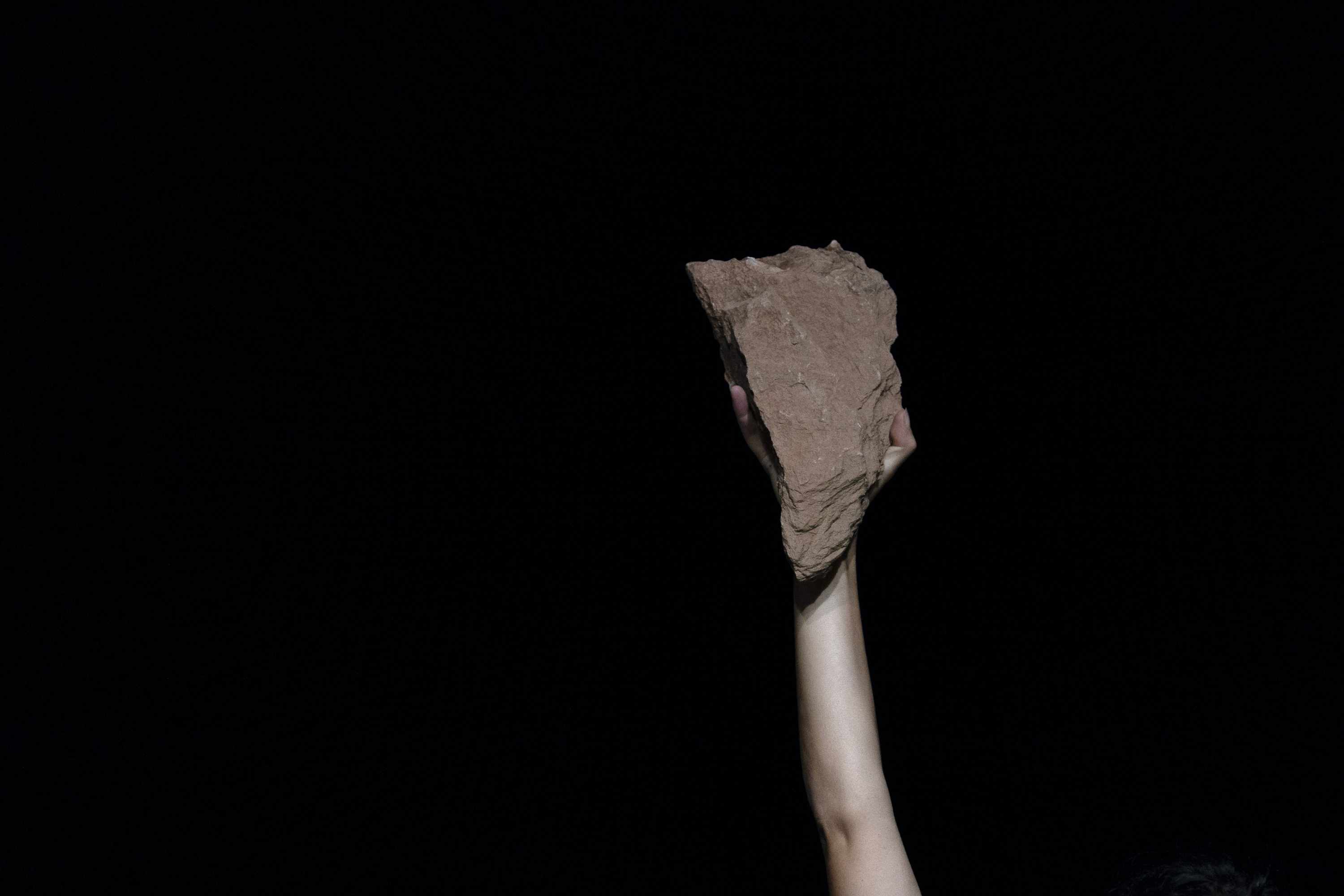
After developing the performance in different kinds of spaces—art galleries, educational contexts—Heart Brake’s official stage premiere was on December 3rd, 2025, in Frascati Theater’s black box space. The performance began when the two figures wearing similar two-piece uniforms came in sideways through the audience entrance, carrying a big belly-sized rock, taking turns sinking from its weight. Center stage, they put the rock down and split to settle on either side of the stage. There, each attended to a separate low platform, bearing a large stone with metal rods sticking out in a line, surrounded by working objects: water bucket, hose, hammer, cloth, protective mask. They went to labor—in tandem, though seemingly without immediacy to each other. A series of episodic movements followed, where the two continued to shift in composition to each other, as if sketching different possible interrelations across the intermediate black space. Sometimes they harmonized through humming, co-compositing on stage without contact, and then losing their consonance. Occasionally, a moment would open up when they would suddenly enter each other’s realms: as one balanced a flat rock against her face, the other came over and stacked a second on top. They got low to the ground, approached each other butt-first—limbs entangling, crossing the floor—and then rose together, counter-balancing. The black box, which conventionally gestures at the invisibility of the theatrical apparatus, participated in these shifts through overt sound design, light effects and even smoke. A sonic all-over contraption weaved as their syncopated double hammering, amplified through contact microphones, played back in slight delay, the sound clashing into itself. Wet stone debris haloed the workstations on the floor. Anything can be music, as long as it bears some patterns of organization. Even the smooth and opaque, like stone, is textured with lines along which it can break. Stone appears as mountain, its song, boulder, rock, the breaking, dust: all singulars, but not individuals; part of a situation, charged as unfolding surround.
In the second act, three voices (one of which was disembodied, projected on a small subtitle screen hung up high) narrated the myth of Wilgefortis, a medieval princess unwilling to be married off by their father (“You know very well that only to ambiguity I can give myself”). Imprisoned for this “disobedience,” they grow a beard, to which the father sentences them to crucifixion—arguably to concretize the death he believed had already ensued symbolically. Across this, Wilgefortis became a figure of protection for “people with a broken heart,” immortalized as a Catholic saint. Decanonized decades later, the myth nevertheless persists. Decanonized but unerased, sediment remains—lines that open stone onto its infinite faces across indeterminate scale. Perhaps because myth is itself such a line, like Wilgefortis’ beard—not the representation of refusal but the very form that refusal takes. The act next developed into a re-enactment of the saint’s story, restaging a Wilgefortis scene from the film Freak Orlando (1981) by Ulrike Ottinger—the baroque masterpiece of body-monstrosity and costumed tableau that achieves the camp paradox of seriousness about unseriousness. Damiani names this, in the press release, “the subversive irony that is experienced on the path to setting oneself, and each other, free.” The performers took turns embodying Wilgefortis by donning a stiff, large dress that functioned both as a garment and a façade. There was a drum set for hammering a beat, but also to scream into under a kitchen towel for the father’s lines. “Do as I say!” The protective mask doubled as the beard, which at one point appeared to float without anything behind it. Without center-wholeness, outlines cease to divide inside from out. The duality of subversion falters as surface doesn’t oppose core, as core is compressed surface. There’s a sculptural drinking chalice that Wilgefortis’ mourning girlfriend poured Martini dry vermouth into. Momentarily stepping out of the theatrical frame—or rather, onto it—she addressed the audience directly, announcing that, due to budget cuts, only one audience member could be offered the drink. Being chosen would come with the task of deciding whether to keep it for themselves or share it among the audience—a question that was left open.
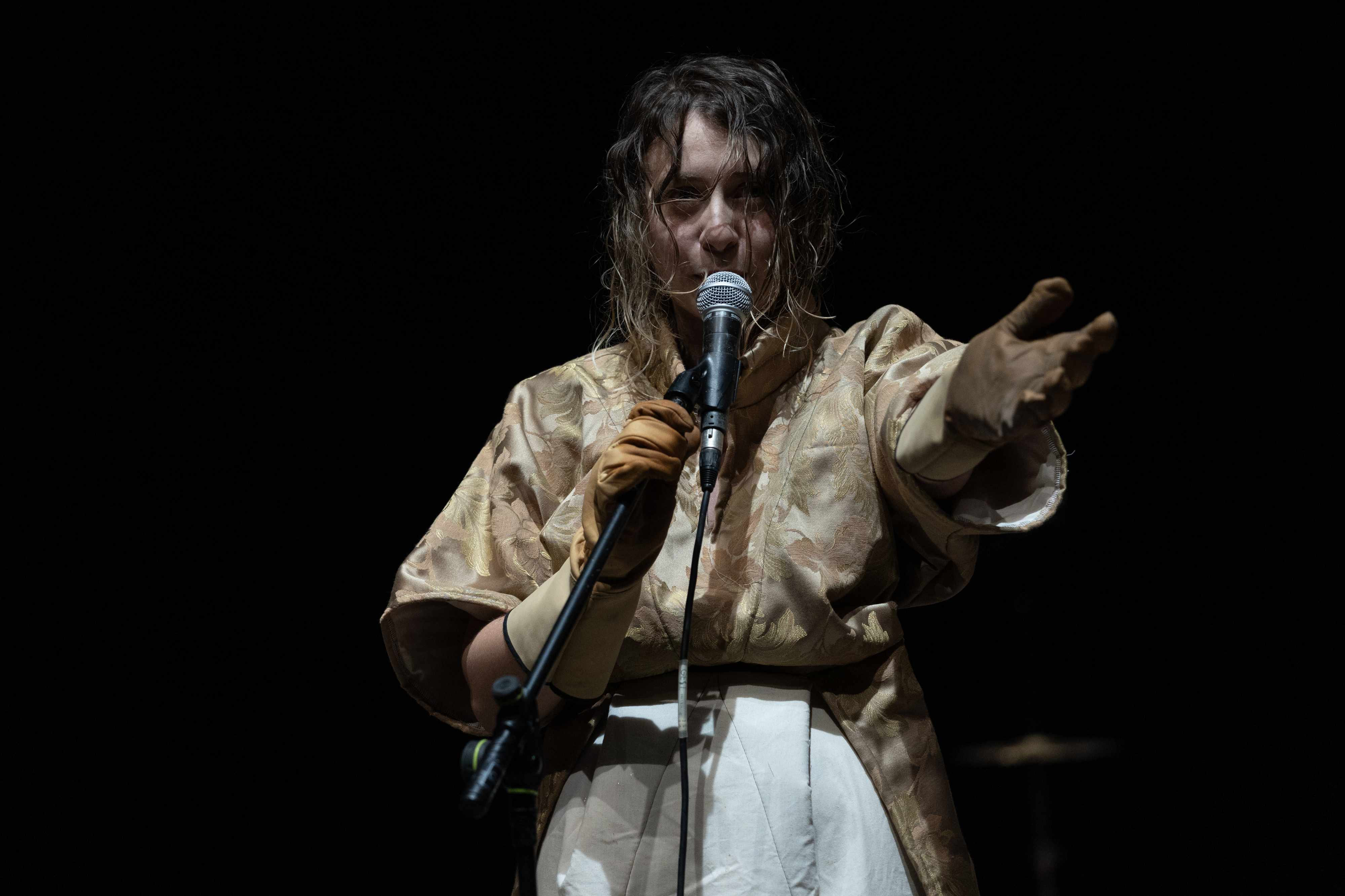
In the final act—slipping from camp into recursive earnestness—Damiani gets a spotlight and delivers an unguarded speech. Dispensing with the microphone half-way, she posits a reality by declaration: “Let it be only rays of light passing through the crack, through us, now. Let there be only dance and brilliant dust now.” Summoning, as prayer and prophecy, passing through the performer who floats thinner than what passes through her. As the escalating finale, the largest rock yet is wheeled in. Protective goggles are distributed to the audience; some are advised to move away. The large hammers appear and the two figures strike in alternation. The length and strength of the arm wielding the hammer determines a tempo. Hit, hit, hit—the brakes in-between pace the blows that allow for co-implication in the breaking. When a mass’s centering is broken, gravity still works, but on absence. Masses hold together by the spacing that surrounds the blows. Rhythm is a bridge wide enough for syncopation. Bridging doesn’t require that either end be fully formed, but this particular bridging did require gloves and masks and attuning calls: not symbols or representations, but extensions of the body’s relation to sediment, as those very bodies—shaped by myth and presenting as the form that myth takes—burst through myth. At the lines of the seams in the pressed stone, when it breaks, the nothing is concretely made. The stone is ravaged, spread out all over as shards and dust, its constitution dispersed into more surface area—in their hair, on their pants. The sound effects cut and the house lights come up in the geological surround of the historical present.
- “A grief more deep than me” is Anne Carson’s translation of Cassandra’s outcry in Aeschylus’ Agamemnon, upon receiving a prophetic vision of the destruction of the inherited order, to which she too will succumb. “Cassadra Float Can” in Float (New York: Knopff, 2016).
- Damiani attributes the phrase to writer Gargi Bhattacharyya’s We, the Heartbroken (London: Hajar, 2023).