Mamma Mia! Here We Go Again: Art, Motherhood and the Lure of the Universal Mom
08-12-2025
I recently came across a short clip from Sesame Street online. It’s 1994, and the Cuban salsa singer Celia Cruz is belting out an impromptu rendition of her hit “La Quimbara” while gathered neighbors—human and muppet alike—move their bodies and sing along raucously. I found myself marveling at the chorus of muppets and children as they bopped and jangled their limbs and threw their heads back in order to bellow the call and response “Eh mamá, eh mamá!” The muppets struck me in this moment as a special kind of proxy, both contained and boundless: for the imagination of Jim Hensen, of course; for the benevolence, creativity and care espoused by the whole Sesame Street production; for a mother.
For many of us cuspy Gen X-ers and older millenial North Americans, Sesame Street became a kind of ersatz caregiver as we were plunked down in front of the television before school, after school, weekends, sick days. Did a muppet teach me the ABCs? Quite possibly, I can’t remember. The muppets in particular situated the acts attributed to the teacher, and often the mother, as part of the fabric of a neighborhood stoop—messy and temperamental and collective and intertwined with the world around it. And, perhaps equally progressive, Sesame Street offered for many a welcome and exponentially more joyful replacement to the moralizing and socializing function of a previous era's fairy tales.
It seemed strange to me then that the fairy tale, with its allegorized disciplinary structures, guided a suite of recent Dutch exhibitions about mothers and motherhood. These exhibitions have positioned the representation of individualized motherhood as a defiant act, one that might disrupt the marginalized yet idealized status of the mother across time. What defines a mother—and whether birth or even the existence of a child are necessary constituents—has been engaged at length in literature and academia (at least since the 1970s and again in the last decade) often with a focus on Marxist or Marx-ish theories of social reproduction. The mother, at least for the political left, has been understood not as a symbolic figure, but a real, material one, shaped by and inextricable from the web of social forces that make life possible for some and nearly impossible for others. Wrapped up in this are the costs of childcare, healthcare, housing, access to social goods including parks, libraries and clean air. Artists, of course, have also engaged in depicting or enacting this social life of motherhood. A few years ago, Ghislaine Leung modified the gallery opening times of her solo exhibition at Essex Street to coincide with the minimal amount of childcare-free studio hours she was able to maintain. Positioning work and (reproductive) labor as common factors in the life of an artist and mother inevitably leads back to Mierle Laderman Ukeles, whose maintenance work in the gallery and long-running collaboration with New York City sanitation workers delineated in her words the “death instinct” of capitalism, which isolates and marginalizes those who (sometimes literally) clean up the shit.
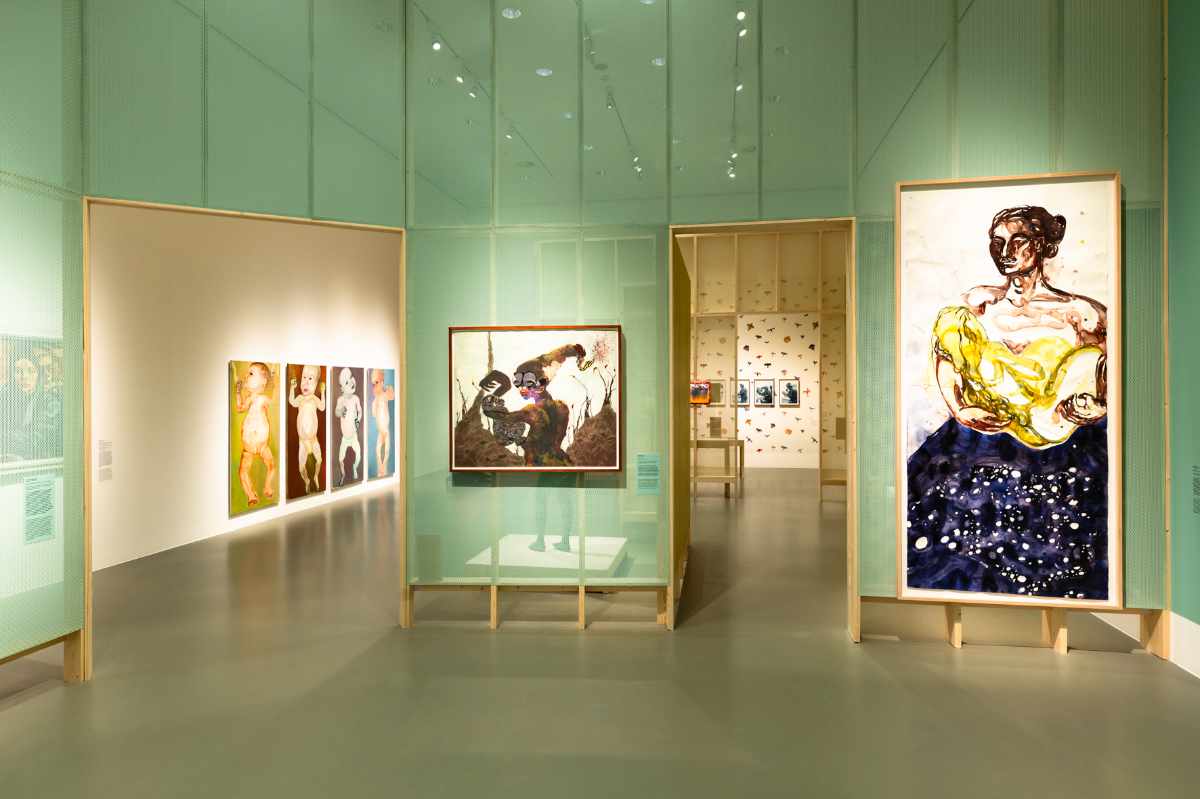
In the Dutch art context, however, motherhood has been a feel-good affair literally coated in pink. In “Good Mom/Bad Mom” at the Centraal Museum in Utrecht (which ran from April to September 2025), an expanse of pastel rooms displayed 150 works by more than 60 artists. Curators Heske ten Cate and Laurie Cluitmans set out to prove how motherhood is no “meagre aside in Western art history,” but a rich thematic that, if accurately depicted by a mother herself, defies entrenched cliches of maternal care and sacrifice. The work of making a more complex art of motherhood (which was, alongside birth, deemed “universal”) recognizes that artistic practice and mothering don’t need to be separated but are, as one wall text noted, “compatible.” The so-called “artist-mother” thereby functioned in the exhibition as a hybrid figure, highlighting the possibilities for an image of motherhood that transcends cliches while also finding in the artwork a site for depicting the “taboo” subjects (especially birth and, indeed, caregiving). In the rooms that followed, the curators assembled works that almost entirely featured—depended on—legible signifiers of (biological) motherhood: figural or painted (self-)portraiture predominated, the better to establish an unequivocal set of visual guidelines for what mothers (should) look like.
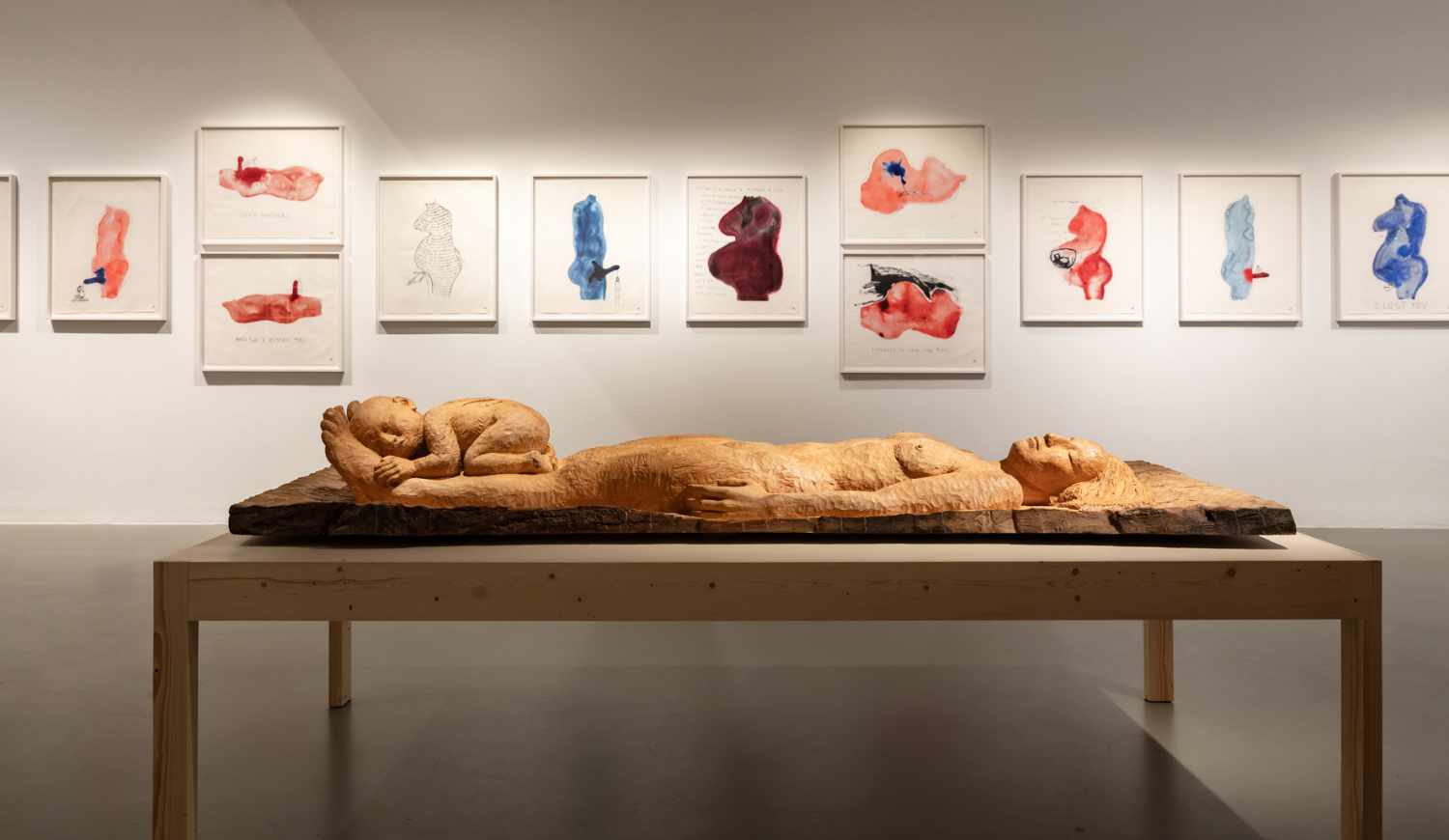
“Good Mom/Bad Mom” with its century-spanning collection of works followed similar exhibitions in theme if not always in tone, such as “MOMMY” (Yale Union, 2015), “La Grande Madre” (Fondazione Nicola Trussardi, 2015), “Mother!” (Louisiana Museum of Contemporary Art, 2021), among others. The Centraal Museum effort may have been a little late to the party, but nevertheless committed to its apparently radical (re)presentation and (re)reading of works within the frame of a present, intentional and unapologetic motherhood. This approach, however, had a flattening effect, in which works that might have illustrated the entanglement of motherhood with other potentially complex social systems were glossed over. Louise Bourgeois and Tracey Emin’s collaborative canvases Do Not Abandon Me (2009-10), which mix humor and ethereality with body horror in their pigment-stained pregnant bodies and engorged genitalia were actually, according to the exhibition, an illustration of “two artists’…musings on self-determination, relationships, desires and artistry.” Tala Madani’s series “Shit Moms” (2019–) was framed as an imperfectly intimate portrait of motherhood, in which the painter’s humanoid smears of brown and white paint depicted the uncomfortable coalescence of mother and child. Not included in this reading was Madani’s aligning of motherhood with the ways incarcerated people or political prisoners have smeared their excrement in acts of protest. Even as the exhibition trumpeted the collective practice of motherhood, the mother was routinely separated, atomized, cut off from other mothers and other people.
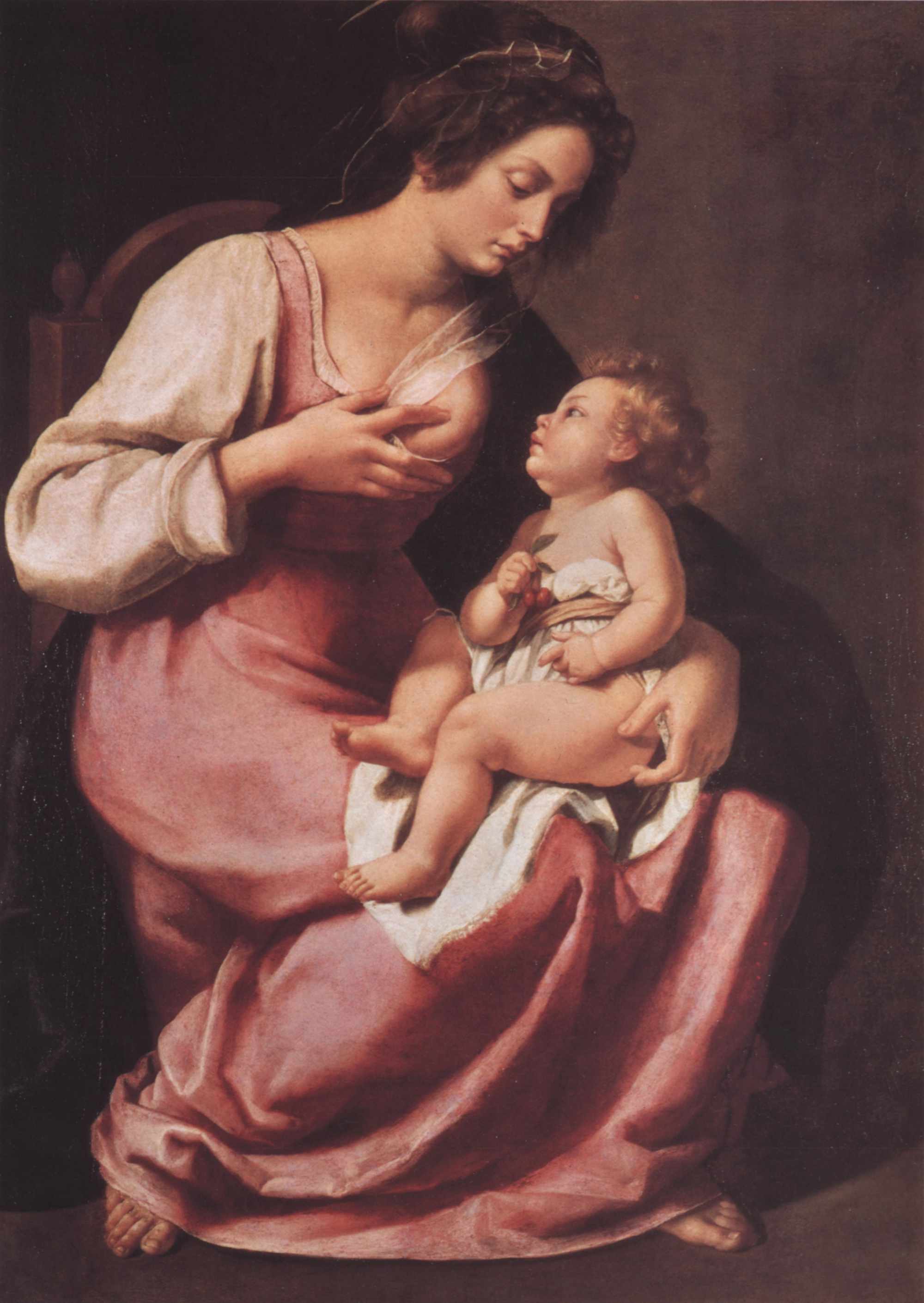
The exhibition also relied on a well-trodden argument that the mother has either been erased from art history or presented only within a restrictive iconography of the Virgin Mary and the nursing Madonna. To simultaneously reinforce and debunk this claim, Artemisia Gentileschi’s Madonna and Child (1613) was hauled out of the Uffizi and hung at the start of the show alongside more contemporary variations on the same theme, where the visitor was told the Baroque painter “wanted to capture the fatigue of early motherhood.” Scholars have written about the way Artemisia’s historic figures (from Judith to Mary Magdalene) resemble the painter herself. Yet rather than draw on these kinds of feminist interpretations, the curators instead focused without any meaningful analysis on how the portrait communicates “that breastfeeding is not a self-evident act.” What is or isn’t “self-evident” about the portrait, what image of breastfeeding is being refuted here, or what such a refutation says about identifications with the Madonna (then and now) went uninterrogated.
Having interrupted Western art history and its engrained paternalisms, the rest of the mostly contemporary works on display were freed from the constraints of genre. There was a mom with a French moustache, a mom carved from wood lying naked and supine with a baby cradled at her feet, a more gestural mom with babies bundled and encircling her heart, a series of bulbous, grasping babies painted by Marlene Dumas. Yet, even if it seemed like a mom could be anything, could look like anything, the proliferation of pregnant bodies told a different story. In fact there were so many tumescent bellies (and babies that resembled them) in the exhibition’s first half that it was hard to imagine motherhood might develop from any other means. Surrounded by pregnancy, the curators’ inclusive opening invocation of “co-mothers, adoptive mothers, never mothers” started to feel pretty disingenuous. Representations of birth were mostly elided too, taking on a more allegorical function as the ultimate creative act akin only to the work of the artist.¹ This guiding principle also stifled any deeper engagement in the artist-mother’s double bind: torn between competing creative acts, they are called bad by society if they prize art making above maternal responsibility. Instead of an excursion into what a “bad mom” might look like² (here I’m thinking about the writer Ayelet Waldman’s confession that she loved her husband more than her kids), “Good Mom/Bad Mom” neutralized the seeming provocation in their title from the jump. There is no such thing as a “bad mom,” the exhibition seemed to conclude, so long as the mother is detached from a defined social or political context; they can avoid the conflict between making art and making life by simply producing that which comes most naturally: an image of themself.
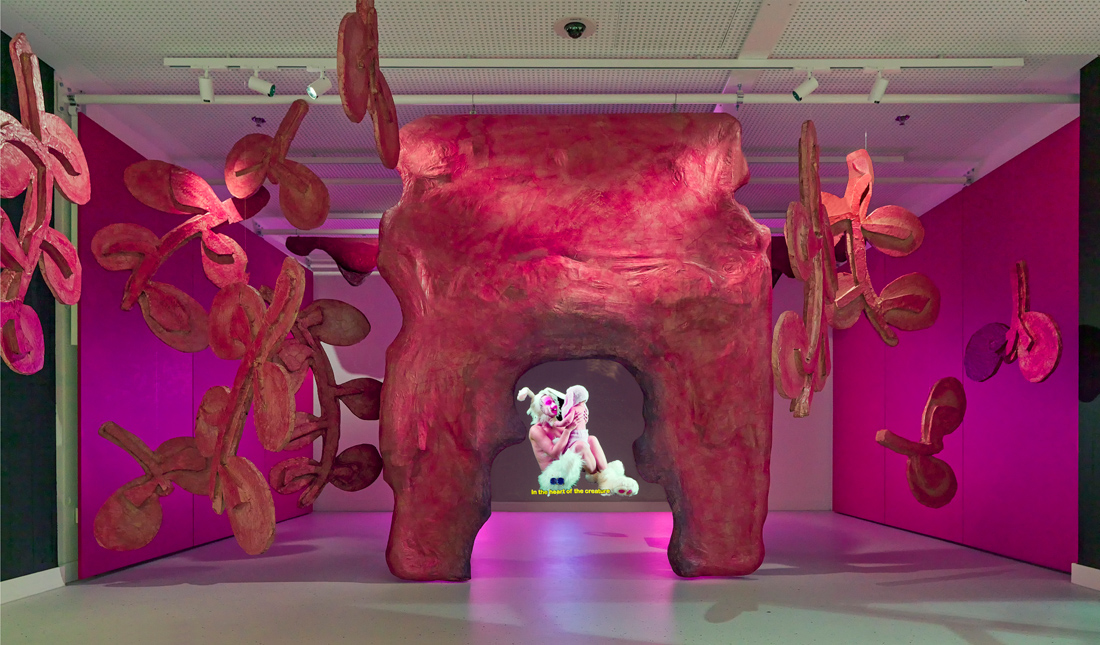
In Amsterdam, Puck Verkade’s solo exhibition “Uprooted,” currently showing in the newly-renovated exhibition space inside the Nederlandsche Bank, constructs its own mythological tale that (re)imagines the mother as not only good, but able to heal the world. The centerpiece of the exhibition is a titular video installation (2023–) in which a short fable—complete with rhyming couplets delivered in a British-accented child’s voice—narrates the destruction of Mother Earth by a malevolent “gardener.” A panacea is offered in the figure of the artist herself who, heavily pregnant and metamorphosed via prosthetics into a human-sized bunny rabbit, implants herself in the womb of the earth (accessed via a rabbit hole) where she gives birth to a baby bunny, played by Verkade’s infant child. Onscreen, we’re shown the same figure as in the Gentileschi painting: a new mother cradling a child, “a natural process as old as time told,” the voiceover trills. Verkade’s presence in the film (a pregnant person, dressed as an animal, simulating birth) may strike some as daring, a refusal to hide or separate one’s motherhood from their artistic work. This performance, however kinetic and psychedelic, which proposes narrative climax as a moment of cross-species alliance, struck me as isolating and lifeless. The birth is presented through a jumble of illustrated tendrils that radiate across Verkade, while the outside environment—still also a womb—is empty and dark. Is this a gesture towards the isolation experienced by human mothers? Are the bunnies bound for a similar fate? As if to curtail such reflections, the narration intones “a new garden born, where all life belongs.”
There are an abundance of grand metaphors throughout “Uprooted,” all in the service of a rather literal reading of Peter Lovelock’s Gaia hypothesis from the 1970s, which understands earth as a living organism able to self-regulate. But what are the actual consequences for mothers, motherhood, their children (all of us) on a planet that is not regenerating and can no longer sustain life? If you’re wondering how we got here, you need only ascend one floor from the exhibition space to the bank’s permanent display of money and other bank artifacts. At the exact spot above where Verkade’s video is playing stands a tranche of imitation gold bars, each about the size of a newborn baby.
Over the past couple of years, I’ve watched as shows, symposia, podcasts, books and performances devoted to motherhood have cropped up around the country. Though inflected with urgency and a call for collectivity, in their lack of specific and deliberate political embedding, this output has produced a mostly inert and uncritical discourse. Even as some curators and artists have teamed up with researchers or activists, it’s notable that these presentations of motherhood as or intersecting with art-making have not included more direct kinds of actual collective action or political work. While not unique in kind, what’s striking about the Dutch iterations of the motherhood-themed show is the extent to which they have positioned mothering as distinct from the economic and political realities of daily life while still emphasizing that the representation of motherhood is an emancipatory act. Predictably, the same images emerge again and again of care, love and nurture: those very characteristics that are said to be outdated and cliche. So, what might more expansive forms of mothering look like? How can these forms be made possible especially after more than a decade of austerity and the continued predations of a right-wing government? What if mothering is not entirely or mostly dependent on the mother as primary caregiver? To answer these questions, however, would demand that we desanctify the image of the mother and really consider how motherhood as a practice imbricates with other forms of reproductive labor. While these forms have been given lip service here (especially at the Centraal Museum), the ways in which the mother not only reproduces new life but also reproduces social relations—whether as a new worker, new consumer, new teacher, new soldier, new billionaire fascist—are often overlooked in place of depicting the mother as a romanticized and universalized creative force.
It’s possible that this proliferation of artist-mother themed programming generates collectivity, solidarity and a space for reflection in defiance of patriarchal and capitalist norms or the scourge of the tradwife. Although the curatorial ambit of “Good Mom/Bad Mom” was to puncture such regressive images of the mother, it still relied on the accumulation of a set of identifiable visual tropes that tended to ignore potentially more evocative kinds of abstraction such as the work of Leung or Mary Kelly, whose Post-Partum Document (1973-79) is an archival and diagrammatic work that eschews the image in order to show how mother is a position or a perspective.
I can certainly appreciate the desire to celebrate a greater degree of visibility in regard to depictions of motherhood; to fill a gallery, or museum for that matter, with moms young, old, middle-aged, present, vacant, good, bad. Though I wouldn’t mind seeing the world too—to see the holes and missed opportunities; to see the ways a mother doesn’t look like a mother mother, to see a proxy mother. But a proxy is uncomfortable. It might teach your kid the alphabet in your place. A proxy might make you hate your mother; it might reveal that your mom went to Australia with her boyfriend and left you in the hands of a demonic baby sitter³; it’s the tattered copy of Our Bodies Ourselves (1973) on the bookshelf; it’s Carmen Winant’s large scale photographic work The Last Safe Abortion (2023) which includes documentation produced of and by abortion care workers; it’s freedom from the expectation as well as the reinvention of the thing itself; it’s a gregarious and incorrigible muppet operated by a metal rod and an invisible hand. Perhaps the proxy can trouble the readability of mother and motherhood by allowing for new signifiers beyond the good mom (who looks like a mom) and the bad mom (who also looks like a mom), even if it doesn’t do away with the existence or reliance on an originary mother in art or in life.
And, finally, what if instead of the mother being the art, the art is the mother? I’ve not encountered Iris Touliatou’s work in any motherhood-themed exhibition in the Netherlands or elsewhere, though “mothers” was the name of the artist’s solo exhibition at Sylvia Kouvali (formerly Rodeo) in London in 2022. In the gallery, Touliatou assembled a rough matrix of mothers in the form of metal drinking fountains connected to one another and the building’s water system by a network of copper pipes. Touliatou works by making visible through acts of construction or re-engineering often mundane yet life-supporting infrastructure—electricity, water, housing, telecommunication. For Touliatou, these are systems that can be constructed through and as objects, and in the case of the drinking fountain she showcased a quotidian triumph of communal architecture, one that might sustain the public however unevenly and unequally distributed. In the accompanying exhibition text for “mothers,” Touliatou asked in list form: “What is still available and to whom? When does the work start and when does the work stop? Are we allowed? Are they autonomous? Can we rely on them? How do we care? How much of a commitment is that?” The same questions could be asked of the mother or of the institution of motherhood, and in the same breath demanded of those same structures and systems that reproduce and obstruct motherhood. Touliatou asks in order to imagine what isn’t there or what happens when there’s not enough or when there is never enough, and to propose a work of engineering that gurgles and hums and can’t save the world though it satisfies a basic need.
- A few exceptions appeared in Rineke Dijkstra’s photographic triptych “New Mothers” (1994), and a bright yellow wall hung with three paintings of cropped bodies and vulvic forms in stages of radiant opening.
- Because the exhibition continuously presented motherhood and mothering as predicated on giving birth, the topic of abortion was a gnawing and unresolved presence throughout. Abortion is certainly a part of motherhood. Many people who seek abortion care have previously given birth or are already mothers, yet the topic received little attention in the gallery and was filed under broader themes like bodily autonomy and self determination, or placed in an archival vitrine (fascinating but separate from the art on display). When abortion was included as a subject of art making, it was done so ham-handedly as in the wall text for Paula Rego’s unnerving etching—part of her abortion series depicting illegal back-room abortions in 1990s Portugal—which read bizarrely, “she depicted women giving birth in filthy rooms.”
- This is not a personal anecdote but the inciting incident of the 1991 dark comedy Don’t Tell Mom The Babysitter’s Dead starring Christina Applegate, which according to a 15-year-old I know, is (still) a very good movie.